
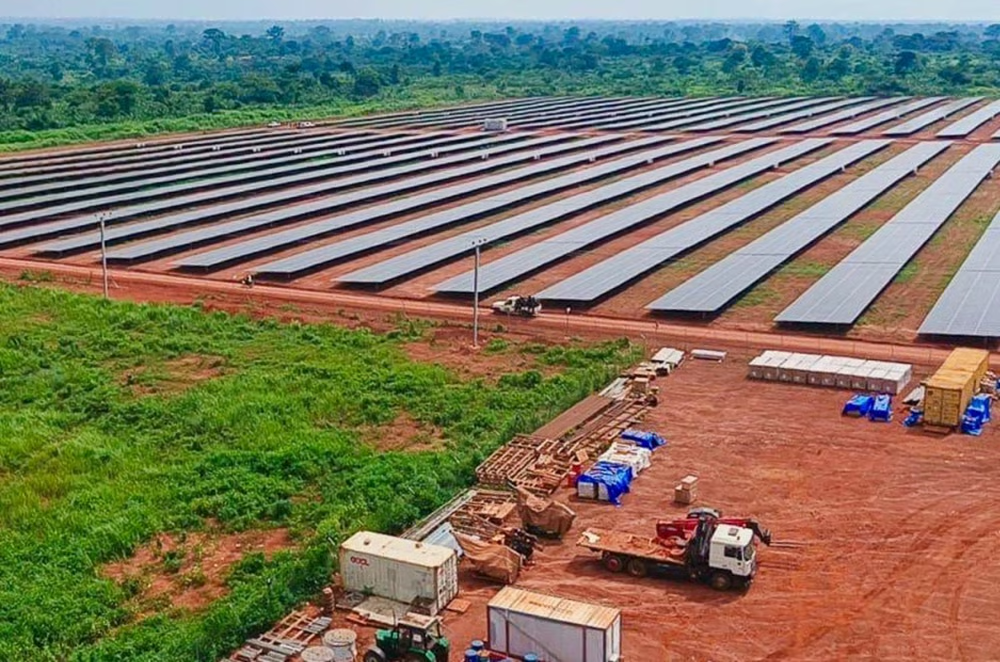

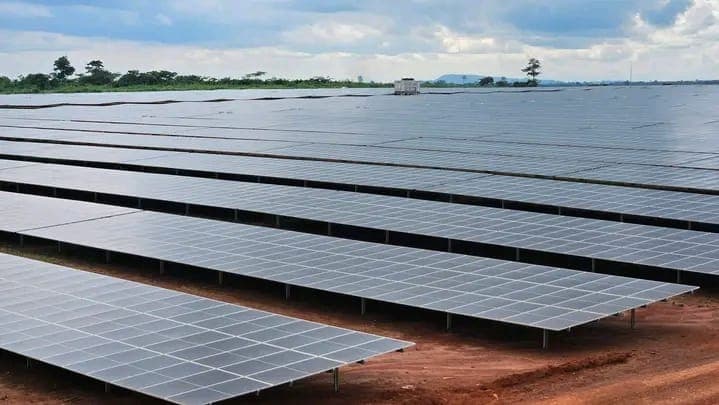
In Bimbo, on the outskirts of Bangui, the final preparations are underway. This Friday, August 7, President Faustin-Archange Touadéra will inaugurate the first phase of the Sakaï 2 photovoltaic solar field. Fifteen megawatts will be immediately fed into the national grid, before progressively increasing to 60 MW. For a country facing recurring power cuts, this commissioning represents an important milestone. It is expected to improve electricity supply to Bangui, Bimbo, and surrounding communities.
The project is the result of an energy partnership established between Bangui and Abu Dhabi. Its foundation stone was laid on August 14, 2025, by the Head of State. The investment, estimated at $90 million, or nearly 50 billion CFA francs, is fully financed by the Emirati group Global South Utilities Power (GSU). Construction was entrusted to a Chinese company commissioned by GSU under a turnkey contract [the acronym “SSG” in the original text should be verified with the source]. Covering nearly 150 hectares in Bimbo, southwest of the capital, the solar park is among the largest solar infrastructure projects ever carried out in the Central African Republic.
Beyond its scale, Sakaï 2 illustrates the energy transition undertaken by the Central African authorities since Faustin-Archange Touadéra came to power in 2016. At that time, the country had only around 37 MW of installed capacity. According to figures presented by the president in his latest State of the Nation address, this capacity has now reached 140 MW. This progress is the result of both the rehabilitation of existing infrastructure, particularly the Boali 1 and Boali 2 hydroelectric dams, and the commissioning of new facilities, including the Sakaï and Danzi solar power plants, the latter developing a capacity of 25 MW. With the full operation of Sakaï 2, national capacity is expected to reach 200 MW in the medium term. This increase is part of the government’s objective of raising the electricity access rate to 50% by 2030, compared with approximately 17% today. Achieving this goal will require the mobilization of nearly $1.7 billion in investment over the coming years.
The government is counting on this increase in supply to strengthen the performance of Énergie centrafricaine (Enerca), the state-owned company responsible for electricity generation, transmission, and distribution. The ambition is also to support the country’s first industrial projects, secure electricity supply for government institutions, hospitals, and households, while reducing the country’s dependence on hydropower and thermal power plants, which are particularly exposed to climate-related risks and fluctuations in fuel prices.
The new plant is therefore part of a broader strategy to diversify the country’s energy mix. In 2024, two photovoltaic solar power plants with a combined capacity of 40 MW had already been commissioned. In his latest State of the Nation address, Faustin-Archange Touadéra reaffirmed his ambition to expand access to electricity throughout the country by continuing investment in renewable energy, expanding transmission and distribution networks, and mobilizing new technical and financial partners.
Originally Published
Also covered by Ecomatin
Read the original article →