

The electricity deficit remains a major obstacle to the development of the Central African Republic, where Bangui continues to experience regular power cuts. Improving energy supply is therefore a central issue for households, public services, and businesses.
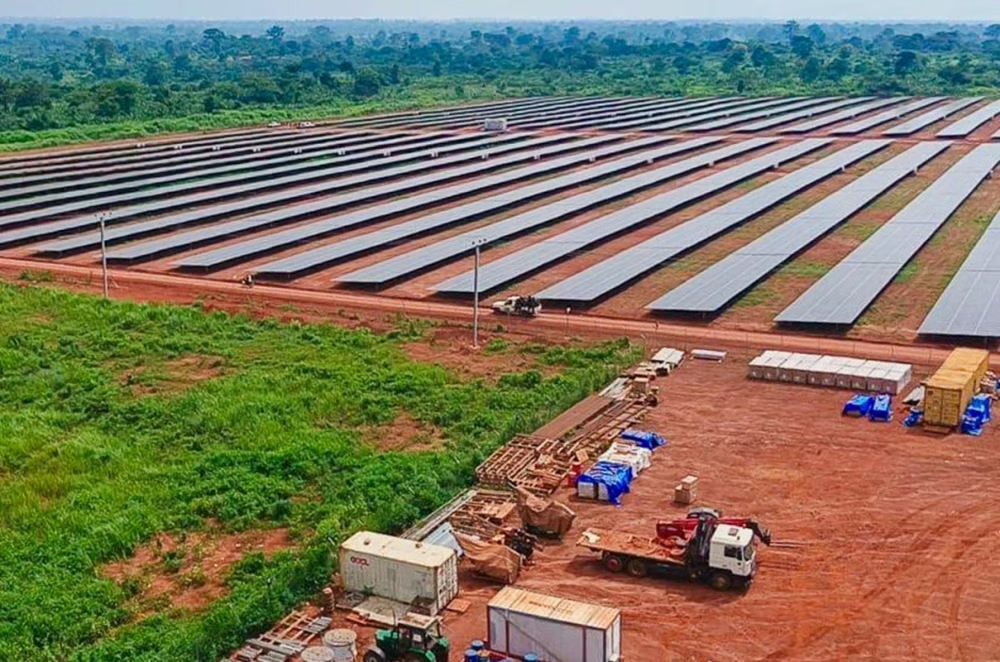
The Central African Republic is taking another step in strengthening its electricity system with the commissioning on August 12 of the Sakaï 2 solar power plant, near Bangui. Developed and owned by Emirati company Global South Utilities (GSU), the facility has a capacity of 50 MW according to the company, compared with 60 MW announced by Central African authorities. GSU estimates that it should increase the country’s national electricity generation capacity by more than 60%.
The connection to the grid took place on the same day during a ceremony chaired by Head of State Faustin-Archange Touadéra, in the presence of Emirati representatives. Central African authorities estimate the investment in the project at $90 million (approximately €78 million). Built in ten months, the plant comprises more than 80,000 photovoltaic panels, 156 inverters, and a 15 MWh battery storage system. According to GSU, it is expected to provide electricity to more than 300,000 households and avoid more than 50,000 tonnes of CO₂ emissions per year.
A Capacity Increase That Changes the Scale of Bangui’s Electricity System
The contribution of Sakaï 2 comes at a time when electricity supply remains insufficient in Bangui, marked by regular power cuts and difficulties in meeting the growing needs of the urban area. The Bangui metropolitan area, home to approximately 1.5 million people out of the country’s 5 million inhabitants, remains exposed to power cuts. Some neighborhoods are already benefiting from electricity generated by Sakaï 2, while others are still waiting for additional works to be completed.
Minister of Public Works Pascal Bida Koyagbele, who is responsible for the project, estimates that the plant will be able to meet the needs of approximately 300,000 households. However, the announced grid connection represents a first step before the solar field is fully integrated into the national grid. The 15 MWh battery system should also help stabilize the grid.
The need nevertheless remains considerable. Only 18.2% of the Central African population had access to electricity in 2024, according to the World Bank. Improving electricity supply therefore also concerns businesses, public services, healthcare facilities, and digital infrastructure.
Partnerships to Strengthen Electricity Supply
The project illustrates the growing involvement of external partners in the Central African electricity sector. Sakaï 2 benefited from concessional financing from the Abu Dhabi Fund for Development. “Every successful infrastructure project begins with a shared vision, but it is partnerships that turn that vision into reality,” said Ali Alshimmari, CEO of GSU.
This cooperation comes as Bangui strengthens its economic relations with Abu Dhabi, particularly since the signing of an economic partnership agreement in March 2025.
Other development partners are also active in the electricity sector. In February 2025, the World Bank estimated its energy portfolio in the Central African Republic at approximately $200 million: $110 million for generation and the grid, $50 million for off-grid solutions, and $40 million for reforms and performance improvements.
In June 2026, it also approved $200 million for the first phase of the regional DARES program, aimed in particular at improving access to reliable, affordable, and clean electricity in the Central African Republic.
With Sakaï 2, the Central African Republic is significantly increasing the generation capacity available around its capital. The challenge now will be to complete the infrastructure needed to deliver this electricity to areas that remain poorly served and to convert this new capacity into more reliable access for communities and economic activities.
Originally Published
Also covered by LS Tribune
Read the original article →