
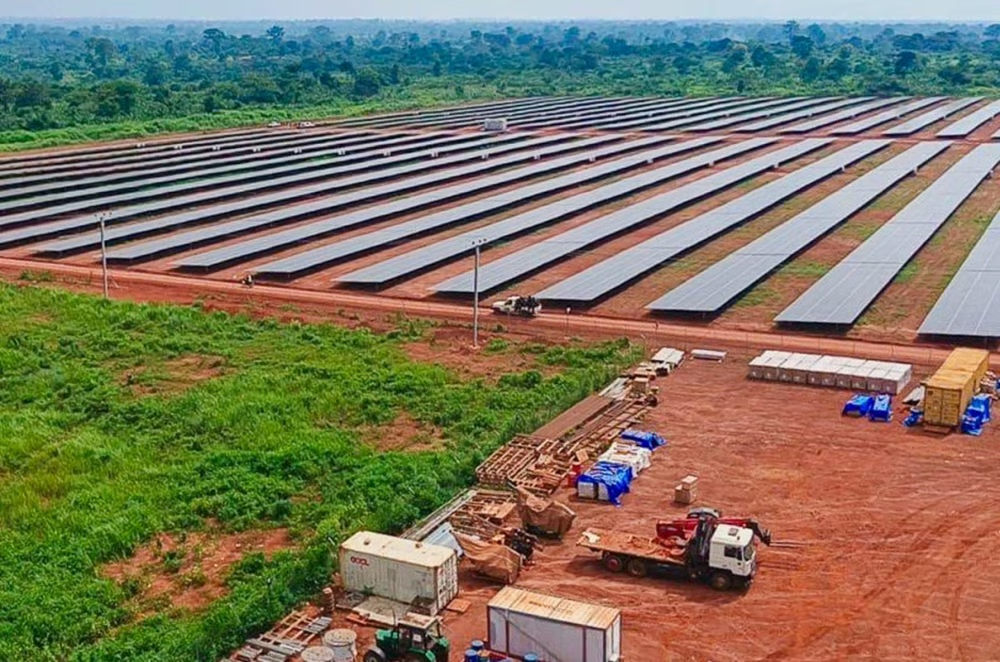

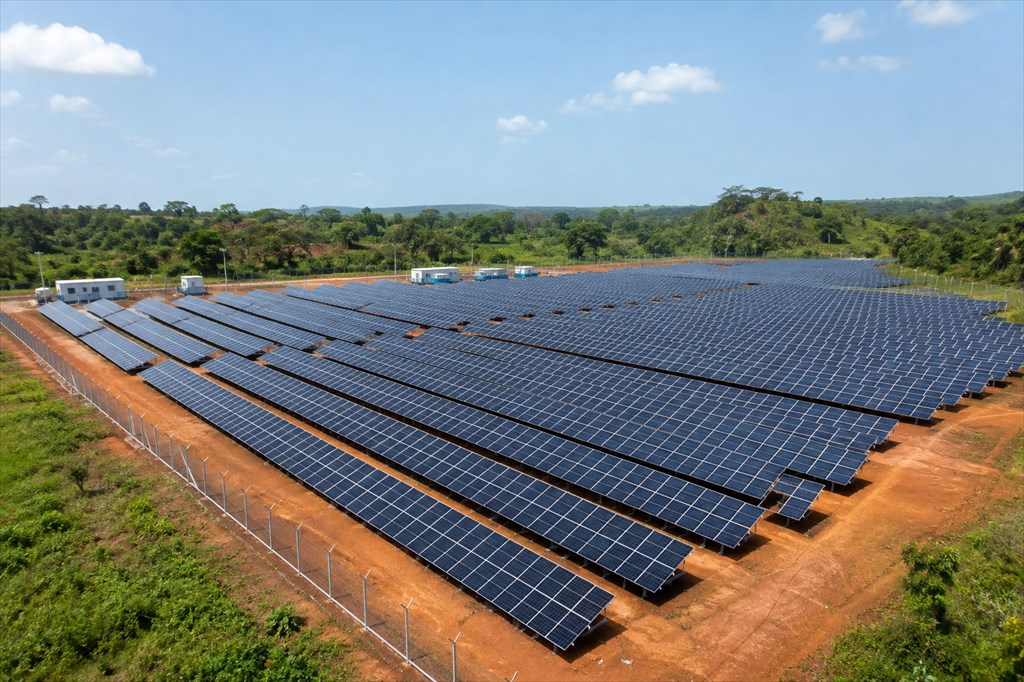
The Central African Republic partially commissioned the Sakaï 2 solar field on August 12, 2026, located in Bimbo, southwest of Bangui. With a total investment cost of USD 90 million, the infrastructure is expected to strengthen the generation capacity of Énergie centrafricaine (ENERCA) and improve electricity supply for approximately 300,000 households.
The power plant was built by Global South Utility Power Enterprises Investment (GSU), whose Managing Director, Alil Al Shimmar, attended the ceremony alongside President Faustin-Archange Touadéra and several Central African authorities. The work was carried out as part of the Sakaï 2 project, which aims to rapidly increase the electricity supply available to Bangui and its surrounding areas.
However, Wednesday’s commissioning only covers part of the planned capacity. Of the 65 MW that the solar field is expected to produce, 15 MW are currently being fed into the ENERCA grid. According to the Acting Minister in charge of Energy Development and Hydraulics, Rufin Benam Belltoungou, this first phase is intended to supply residents in neighborhoods located in the 3rd and 9th districts of Bangui. The power supply is then expected to gradually extend to the other districts by next December.
An Emirati Investment in a Strained Electricity Market
This new infrastructure represents an important contribution to a sector that has faced severe supply challenges for several years. According to World Bank data, only 16.8% of the Central African population had access to electricity in 2024. The grid remains heavily concentrated around Bangui and Boali, while a large part of the national territory remains poorly served or without access to electricity.
In this context, the arrival of new generation capacity should enable ENERCA to meet growing demand. Company data also shows a recent increase in electricity sales. ENERCA sold 166.9 GWh in 2025, compared with 149 GWh in 2024, representing a 12% increase.
However, this growth has not been sufficient to resolve the supply challenges. Bangui continues to experience power outages, particularly due to limited generation capacity and constraints affecting the electricity infrastructure. With its planned 65 MW capacity, Sakaï 2 should therefore help reduce pressure on the grid and gradually expand access to electricity in the capital.
Originally Published
Also covered by Sika finance
Read the original article →